Brief notes on fencing, from the military treatise of Giovanni Alberto Cassani (1603)
Giovanni Alberto Cassani published a military treatise in Naples in 1603.1 In this work he...
Read More

Giovanni Alberto Cassani published a military treatise in Naples in 1603.1 In this work he...
Read More
“Finding yourself assailed by enemies, and supposing there are many of them, the situation demands...
Read MoreThe sixteenth century saw a proliferation of fencing treatises written and published in the Italian peninsula. Some masters and styles have long been well known to fencing historians and modern historical fencers. Other masters,...
Read MoreIn a previous article, a detailed introduction to manuscript Cod. 264.23 was presented along with an English translation of the first two sections, dealing with the single rapier. In this contribution, a translation is presented...
Read MoreThe following translation of the manuscript Cod. Guelf. 264.23 contains the notes of an unknown German speaking student about his fencing lessons at the knight academy at Sorø (Ritterakademie Sorø). It was most likely written...
Read MoreNeither a real weapon, nor a simple cloth: the cape in Italian martial arts. The cape is an item of clothing, subject to the rules of fashion and climate, and cannot be described appropriately by measures and rules, therefore it...
Read MoreArmed civilian conflict was a reality of early modern life, both arranged duels and spontaneous violence. Many masters speak lucidly of deadly combat, or claim direct experience of it, which should not surprise given their...
Read More
The following are partnered drills for the cloak and rapier. It is vital that the attacker...
Read MoreThe following are some suggestions for using the cloak with the rapier. Please note, the techniques will vary from those which can be used with a sidesword, so this should not be taken as a definitive form for all sword types....
Read More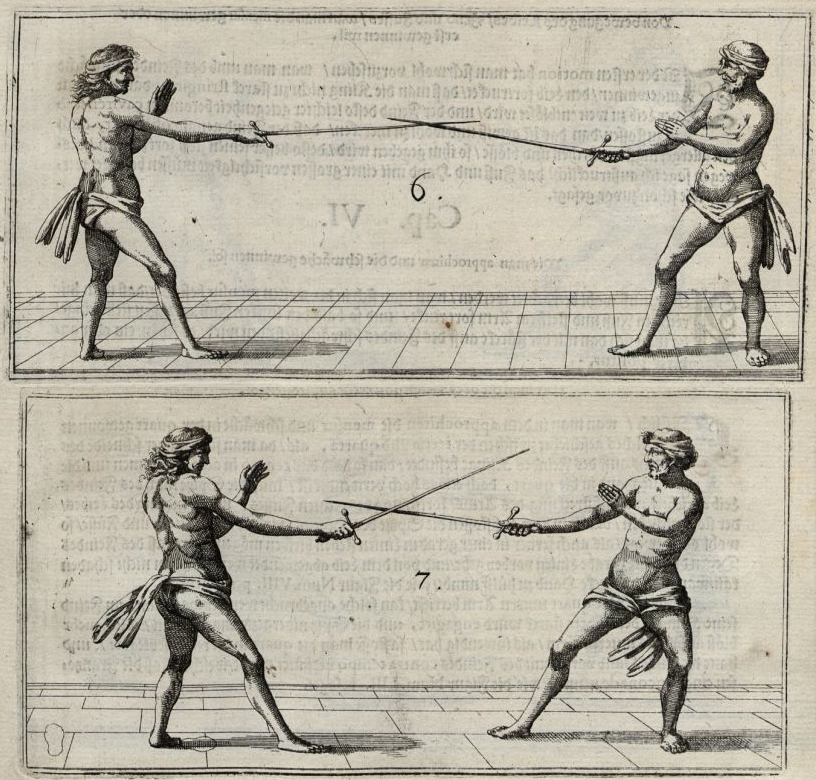
What’s our problem? The main purpose of any fencing art is to keep the fencer safe from the...
Read MoreA few years ago I translated the first book of Mr. Nicolleto Giganti into Castilian. The book I used for the translation was printed in 1644 by Zetter in Frankfurt with the text translated into German and French. I must confess...
Read More
The relative benefit and importance of competition in modern HEMA is a frequent subject of...
Read MoreHerzog August Bibliothek has kindly provided the GHFS with scans of Theodori Verolini’s Meyer and Petter-inspired manual of 1679 and allowed Hroarr to distribute these files as well.
Read More
 Fighters Against Racism
 Acta Periodica Duellatorum